
AI prosecution intelligence
Patent prosecution software with AI inside every matter.
Not a chat box beside a database. OttoFlow™ puts AI inside the record — with the file wrapper, the claims, the examiner’s statistics, and the docket.
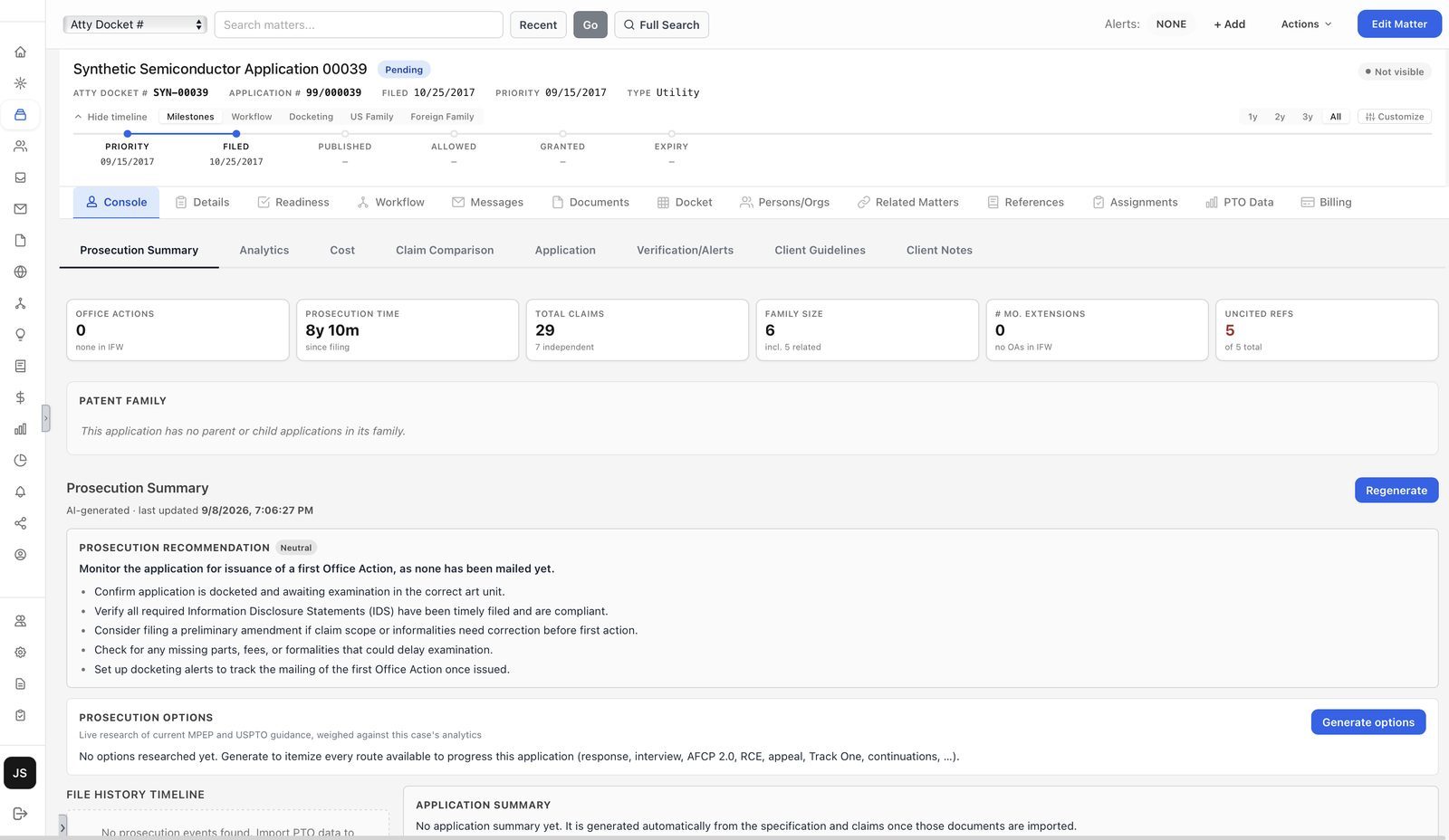
The prosecution console
Every analysis is grounded in the matter’s own documents.
Every analysis in the console reads the file itself — so recommendations come with their sources.
Prosecution & application summaries
The story of the file on one page, generated from the file wrapper and updated as new documents arrive.
Prosecution options
MPEP-grounded, web-search-assisted recommendations after an action — every route available to move the application forward.
Rejection analysis
Grounds, references, and the examiner’s mapping, with §101/102/103/112, restriction, and allowance tags extracted into the docket.
Claim scope comparison
Original, current, and allowed claims side by side, driven by OCR’d claim sets.
Prosecution analytics
Examiner, art-unit, and class comparisons on allowance, pendency, interview benefit, and appeal outcomes.
Value analytics
AI valuation reports, configured at system, firm, and client level — plus a family tree and AI milestones on the timeline.
Bring your own AI
Run it on your AI provider, with your own keys.
OttoFlow runs on the AI provider your firm chooses. Connect your own API keys — the platform isn’t tied to a single model vendor — and every feature runs on your account. Credentials are encrypted at rest, and model overrides are set per feature.
Each AI feature is enabled per tenant, metered with cost pricing, and governed by rate limits and per-user spend limits. An AI Usage page shows who spent what on which feature — the managing partner’s first question.
Eleven gated AI features
Prosecution summary
Application summary
Value analytics
Prosecution options
Rejection analysis
Family tree
Doc AI analysis
AI milestones
Docket tags
Action LLM
Portfolio ontology
Also on every matter: chat and analyze, checklist and workflow generation from documents, natural-language matter search, and action auto-fill.
Skills & orchestration
Turn your firm’s know-how into versioned, shareable skills.
Skills: reusable prompts as assets
System, firm, and personal skills with a prompt drafter to author them. Skills run inside workflows and readiness checklists.
SOML orchestration
A YAML orchestration language with ten step types. Compose “pull the file history, summarize each office action, compare claim scope, save the memo” — without a developer.
Readiness checklists
Checklists mix manual items, AI-skill checks, and Otto HUB™ data checks, so a matter shows what’s done and what’s missing before anything is filed.
The MCP controller
Talk to your docket from Claude, ChatGPT, or Copilot.
OttoFlow ships with a Model Context Protocol (MCP) controller that exposes the platform to any MCP-capable AI. An attorney asks, “What’s due for Client X this month, and which items are still unassigned?” — and gets an answer drawn live from the docket.
Otto HUB™’s MCP controller connects your AI to USPTO and portfolio data. OttoFlow’s connects it to your live docket — to read and to write, through the same scoped, audited permissions a user has.
Read any matter, docket item, document, reference, or billing field — scoped by tenant and privilege
Run Matter Search queries and saved searches
Add reminders and cross off completed work, pre-validated before anything is written
Launch procedures, actions, and workflows; invoke skills and SOML scripts
Retrieve PTO data, file-wrapper documents, and OCR text
Every call metered, rate-limited, and written to the audit stream
Attorney · AI assistant
We filed the response on 17/123,456 yesterday — close out the docket item, and remind me two weeks before the next deadline on that file.
OttoFlow MCP controller · Pre-validation
Matched 17/123,456 → SYN-00039. Open obligation: Response to Non-Final Office Action, due 29 Sep 2026 (hard statutory). File wrapper shows the response received 8 Sep 2026 — filing confirmed. Your privilege: docketing, cross-off level 2 ✓
Will write
1. Complete the Non-Final response obligation — “Response filed 2026-09-08.” 2. Add a reminder 14 days before the next deadline.
Attorney
Confirm.
OttoFlow
Done. Obligation closed and reminder added — both on the matter’s Docket tab and in the audit stream as AI-entered under your name.
Illustrative transcript
What pre-validation checks before an AI write lands
1
Matter
Resolves the application, patent, or matter number the user mentioned — even a partial one — to exactly one matter, and asks if it can’t.
2
Obligation
Matches the instruction to the right open docket item: the Non-Final response, not the IDS due the same week.
3
Rule
Checks the action against the rule library and the item’s status, so a hard statutory deadline can’t be closed without the filing on record.
4
Privilege
Confirms the user’s docketing privilege, shows the exact change for confirmation, and audits the write as AI-entered under their name.
AI-enabled automation
These tools only work on an automated docket.
Each one depends on an automated process underneath it: a docket that knows what arrived, a workflow that knows what stage a matter is in, and a rule library that knows what should have happened.
1
Event
A PTO document lands; the docketing engine identifies it and launches the procedure.
2
Flow
A workflow template fires — stages, tasks, and checklists open with dates synced to the docket.
3
AI tool
A skill or SOML script runs against the file wrapper, the claims, and the record.
4
Output
Checklist results, draft documents, new matters, and alerts are written back with provenance.
5
Verify
A person confirms by exception; the audit trail records the AI’s work and the reviewer.
Notice of Allowance processing
When the NOA procedure fires, OttoFlow launches the NOA workflow and runs an AI readiness review across the file — claims, IDS coverage, priority, drawings, terminal disclaimers, assignments. Each failed check produces a draft response. The attorney reviews a dashboard, not a file wrapper.
Shell creation
An allowance opens a continuation shell before the issue fee is paid; a restriction opens divisional shells; a PCT nearing 30/31 months opens national-phase shells. Each inherits the priority chain, inventors, assignee, references, and cross-cite pool.
Practice error surveillance
Rules compare what happened to what should have: a response filed but not closed, an extension rung passed without a fee, new family citations still uncited. AI reads the documents for the rest — and every finding links to its source.
Open APIs
Anything the interface can do, an API key can do.
The Agent API uses scoped API keys with tenant pinning, idempotency keys on writes, and Swagger/OpenAPI documentation. API-originated docketing launches land in the same Inbox queue, so remote automation still passes human review when your tenant requires it — and CloudEvents webhooks announce what happens inside.
Discovery: capabilities, schemas, and catalogs
Otto launch: trigger procedures and Otto codes remotely
Matters, docket items, documents, and references
Parties, related matters, workflows, tasks, and billing entries
Import rules with AI-suggested mappings, audit history, and rollback
Explore OttoFlow™
Keep exploring OttoFlow.
The platform
Docketing, prosecution, IDS, reporting, portals, and security on one record.
See the platform →Why OttoFlow
Why software, not billable hours, takes the touches out of prosecution.
Read why OttoFlow →The docketing engine
A rule engine that computes every deadline, with provenance on every date.
See the docketing engine →IDS Manager
Prior-art capture, deduplication, and SB/08 generation, in OttoFlow or on its own.
See IDS Manager →See the console on a real rejection.
The guided demo walks from Inbox to docket to client report, the console on a live office action, and the Agent API from a terminal.